

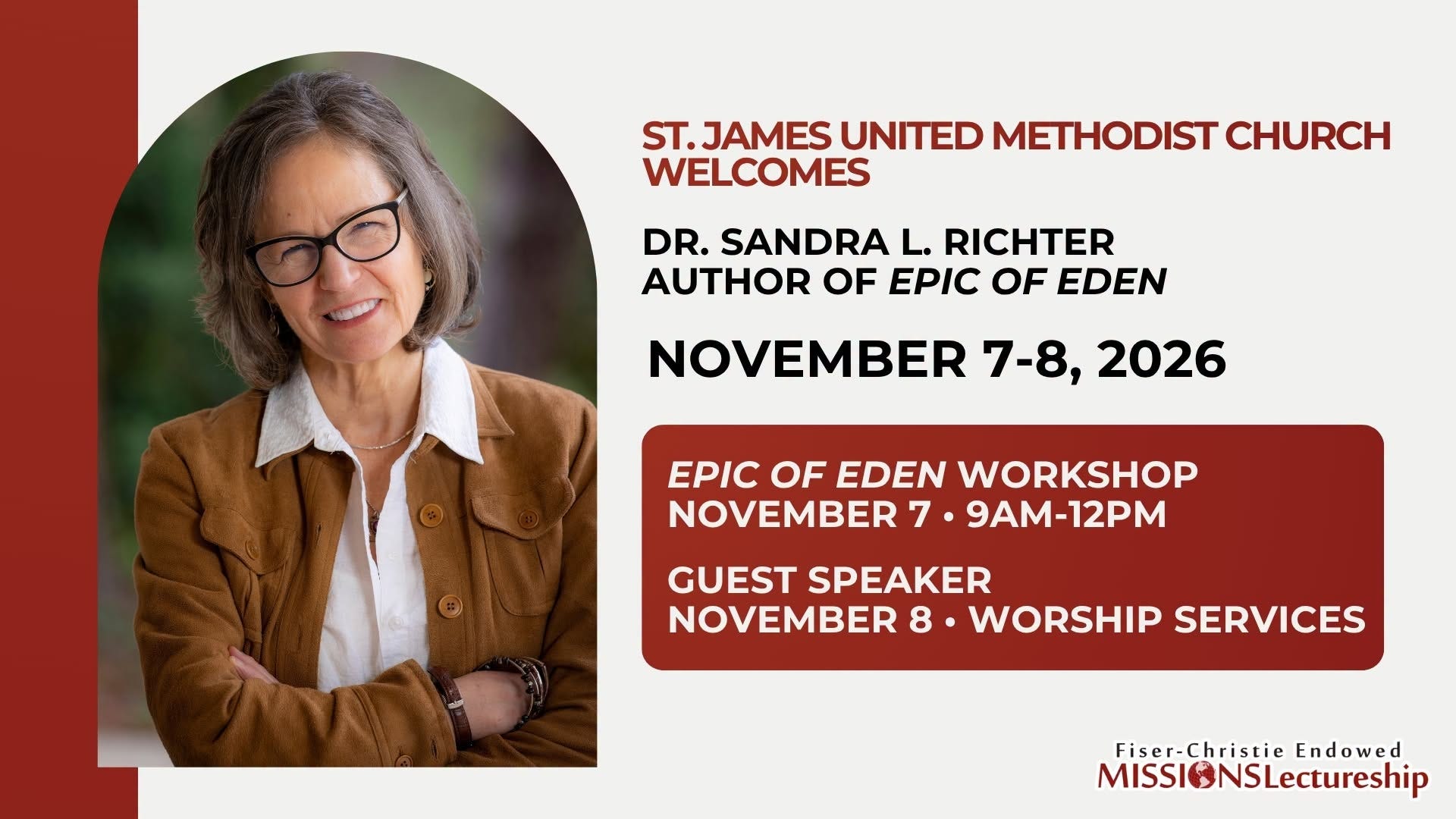
Hello friends! I'm off to Little Rock to do the Fiser-Christie Missions Lectureship at St. James UMC on November 7 & 8th. We'll spend Saturday in a half-day seminar talking through Israel's "real people." This is the material that populates the first two chapters of The Epic of Eden: A Christian Entry into the Old Testament. We’ll have books and study guides available if the lectures intrigue you.
On Sunday we engage the lectureship by talking through creation care as an issue of mission: What do the Bible and Christian discipleship have to say about the way we treat the world around us?
Established in 2013, the Paul Martin Fiser, M.D./Rev. James and Marie Christie Endowed Missions Lectureship was created to help the St. James congregation better understand mission needs and opportunities in our community and world—and inspire meaningful engagement in response.
Each year, the Fiser-Christie Lectureship invites us not only to learn, but to consider what comes next: How are we called to respond? Where can we serve? And how can our faith move us toward meaningful action?
If you’re local, I’d love to see you there as we explore Scripture, creation, and what faithful stewardship looks like in everyday life. No pre-registration required. It looks like we will also have a representative from Plant with Purpose, one of my favorite environmental missions groups.
And in other news, I just came across the first review of the 2nd Edition of The Epic of Eden (whoop!). It is by Dr. Will Ryan and you can read it here. But better ... Ryan and I doing a "deep dive" on his questions about Epic (and the ANE and redemption and a slew of other very cool topics) on November 4th on his podcast. Be looking for it here!
Enjoy this excerpt from Dr. Ryan’s review:
The enduring strength of The Epic of Eden is its insistence that the Old Testament must be understood as an interconnected historical and theological narrative rather than an anthology of disconnected religious stories. Richter recognizes that many Christians are familiar with Abraham, Moses, David, and the prophets yet struggle to locate these figures within the broader development of Israel’s covenant history. Her well-known illustration of organizing the Old Testament closet provides more than an effective teaching device; it identifies a genuine hermeneutical problem. Without an understanding of chronology, geography, covenant, and the cultural world of ancient Israel, readers often interpret Scripture through assumptions foreign to its original setting. Richter’s approach provides a coherent framework through which these historical and theological relationships become intelligible.