

And so it was that when men began to multiply on the face of the land that daughters were born to them, 2and the sons of God saw that the daughters of men were beautiful; and they took wives for themselves, whomever they chose.
3Then the LORD said, “My Spirit shall not contend with man forever, because he also is flesh; 3nevertheless his days shall be one hundred and twenty years.”
4The Nephilim were on the earth in those days, and also afterward, when the sons of God came in to the daughters of men, and they bore children to them. Those were the mighty men who were of old, men of renown.
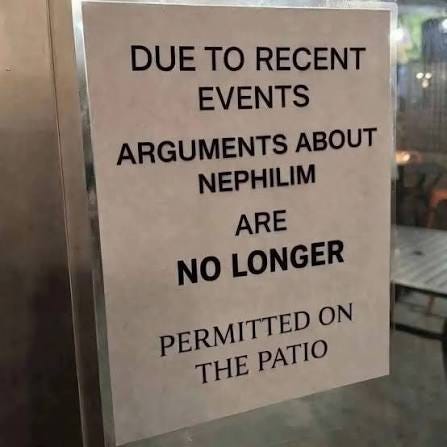
Back to these mysterious characters! In my first post we talked through the interpretation that the “sons of god” are fallen angels who are having sex with human women (“the daughters of men”) and their semi-divine offspring are the Nephilim who are the impetus for the flood. I clarified how this interpretation grew out of Greek Mythology and has no place in biblical theology. Please do go back and read that if you’ve missed it. And if you are curious about the “sons of God” as the offspring of Seth and the “daughters of men” as the daughters of Cain (some call this the “Sethite” view), for the sake of space, let me direct you to The Epic of Eden: A Christian Entry into the Old Testament, 2nd ed. But here, let’s move on to a third interpretation …
Building block one. As many scholars identify, Gen 6:1-4 reflects some aspect of Israel’s earliest perceptions of their ancient world—some would call this the “mythological” aspect of Israelite origins. I would prefer to speak of this as the Bible’s participation in an ancient Near Eastern worldview. And in this worldview to refer to a king as the “son” of this or that deity was absolutely normative. Indeed, our closest linguistic parallel to the language of Gen 6:4 comes from ancient Ugarit where the human king Kirta is identified as the “son of El” (bn il, the Ugaritic equivalent to Hebrew ben ʾĕlōhîm).[1] Even closer to home is the Sumerian King List (c. 2084 BCE), a critically important parallel in our study of Noah’s flood. This text subdivides human history into an age before the flood and an age after the flood—just like our Bibles do. Gilgamesh is a central character in the Sumerian King List. He is described as two-thirds god and one-third human, the son of a deified Sumerian king and the goddess Ninsun. His name is marked with the Akkadian determinative for deity, the dingir sign.[2] Historians widely agree, however, that a real, historical King Gilgamesh ruled Uruk somewhere around 2600 BCE. My point? Identifying a king in Mesopotamia as a member of the divine class (a “son of” the gods) … well, that was a part of their mythology and their worldview.
If we incorporated this background into our reading of Gen 6:1-4, what we would hear is that the ones who are causing God to “contend” with humanity are a cast of royal characters who claim descent from the gods. A close parallel to the Sumerian King List. The difference would be that the Sumerian King list celebrates these royal figures as heroes, whereas the Bible will condemn them.
According to Genesis, what are these kings doing? They are “taking” the “daughters of men” as wives. Some want to paint this behavior as wicked: polygamy, promiscuity, or “right of the first night.” But as the OT does not condemn polygamy, that cannot be the issue. And as the language of the passage is not that of promiscuity or rape, but the standard idiom for marriage (“to take as wives”), that cannot be the issue either. Some say the crime was the “right of the first night”—a practice of kings ancient and modern claiming the right to a bride’s first sexual encounter. As Gilgamesh is guilty of abusing his royal power in just this fashion, this has some potential.[3] But as Adam Miglio points out, there is no actual historical evidence for this practice at any point in Mesopotamian history. Rather, these verses are “almost certainly a literary trope to communicate how egregiously King Gilgamesh distorts family norms.”[4] Moreover, unlike the Gilgamesh epic, Genesis doesn’t communicate any illicit behavior—these characters are simply marrying. And even if the marrying was somehow illegitimate, why would God send a flood to destroy all of humanity because of the crimes of kings?
Building block two. Let’s pay attention to the fact that each of the interpretations of the identity of the “sons of god” we have reviewed (fallen angels, descendants of Seth, or kings with commoners) presupposes that Genesis 6:1-4 is the prologue to the flood story. Thus, this first paragraph of Genesis 6 is supposedly the narrator’s introduction to and rationale for the flood. The idea is that the intermingling of the “sons of God” with the “daughters of men” has introduced some grave new sin that has necessitated the purging of the race.
What would change if we instead concluded with John Sailhamer, that Genesis 6:1-4 was intended as an epilogue to Genesis 4–5—a concluding paragraph to the Adamic Age.[5] Notable parallels to this literary structure may be found in Genesis 11:27-32 and Exodus 1:7 where, following a genealogy, a summary is offered narrating how the main characters took wives, extended their lineage, and moved on to the next chapter of the story. Keeping in mind that the chapter and verse divisions we now find in our Old Testaments were not added to the Bible until centuries after the closing of the canon (in other words, our chapter and verse divisions are not inspired by the Holy Spirit!),[6] there is no scriptural reason to resist Sailhamer’s suggestion and many reasons to embrace it.
If Gen 6:1-4 is indeed a conclusion to the preceding narratives, then the flood account begins with Genesis 6:5:
Then the Lord saw that the wickedness of man was great on the earth, and that every intent of the thoughts of his heart was only evil continually.
As Genesis 6:5 offers the reader all the explanation needed for the catastrophe about to occur, this is compelling. Moreover, it would render Genesis 6:1-4 as a standard literary device, coming at the close of a genealogical list, intended to summarize the narrative that has come before. If Sailhamer is right (and I am inclined to think he is), Genesis 6:1-4 is no longer the reason for the flood, but a paragraph intended to bridge the age of Adam to that of the flood. And therefore, “there is little to arouse our suspicion that the events recounted are anything out of the ordinary.”[7] Rather, “this little patch of narrative is a reminder that the sons of Adam and the daughters of Eve had greatly increased in number, had married, and had continued to have children. The impression it gives is that of an interlude, a calm before the storm.”[8] Much like our parallel text in Matthew 24:
As it was in the days of Noah, so it will be at the coming of the Son of Man. For in the days before the flood, people were eating and drinking,
marrying and giving in marriage, up to the day Noah entered the ark;
and they knew nothing about what would happen until the flood came and took them all away. That is how it will be at the coming of the Son of Man. (Mt 24:37-39 NIV).
So back to our three unidentified characters: the sons of god, the daughters of men, and the Nephilim.
Let’s start with the Nephilim. The Hebrew comes from nāphal (נָפַל) meaning “to fall.” Our first school of interpretation identifies this group as the divine-human offspring of “fallen” angels, and identifies Nephilim as “fallen” as well—superhuman, half-blood angels who must be wiped out in the flood. This interpretation has no biblical analogue. And it is far more likely that nāphal (נָפַל) has to do with the very common idiom to “fall” in battle, most specifically to “by the sword.”[9] Most important, the Bible actually tells us exactly who and what the Nephilim are. They are “the mighty men who were of old, men of renown.”[10] The Nephilim are warriors. And as the linguists will recognize, the Hebrew term nĕphilîm is a qātîl form—“terms for officials and other terms for individuals in legal or cultic contexts.” Thus, it is likely that our Nephilim are in fact a guild of warriors.[11] A guild that survives the flood. Which is why the Nephilim (and their descendants, the “sons of Anak”) reappear in later texts (Num 13:22, 28, 33; Deut 9:2; Josh 15:13-14; 21:11; Judg 1:20). If they were actually super-human, fallen half-angels, whom the flood was designed to annihilate, their survival would be a problem! All told, we are more likely to locate the Nephilim among the warrior guilds of the ancient Near East than among the demigods of Greece.
And what should we make of the “sons of God”? I believe that the reading that accords best with the larger ancient Near Eastern context is that the “sons of God” are in some fashion equivalent to the antediluvian kings of the Sumerian King List, perhaps an idiomatic reference to the “heroes” of the pre-flood world.
The “daughters of men”? These are most simply the marriageable women of that generation. And as in Mattthew 24 (cf. Luke 17:27), this first generation is continuing to participate in that most basic expression of human civilization, taking and giving in marriage, right up to the day of judgement.
All told, these descriptors which seem so foreign to us are simply offering us an idiomatic means by which to refer to the people who populated the antediluvian age. And the talk of marriage in this epilogue? Like Genesis 11:27-32 and Exodus 1:7 this interlude summarizes the previous era and introduces the next. And like Matthew 24:36-39, Genesis 6:1-4 communicates how completely unprepared this generation was for the coming judgment of God.
Thus, the flood and the Second Coming become the great epoch dividers of the human experience. Both are sent to save; both are sent to judge. It is important that we recognize that whereas the Sumerian King List and the Gilgamesh Epic characterize the first age as an age of heroes to be admired and celebrated; the biblical writers identify the first age as an age of depravity to be condemned. And contrary to some of the sensationalistic interpretations of this passage, the crime that must be judged is not the rebellion of fallen angels, but the hubris of humanity. Our problem is not half-breed angels loose on our planet. Our problem … is us.

[1] The tablet containing this epic date to c. 1350 BCE). See Simon Parker, “SONS OF (THE) GOD(S): בני עליון / אלים / (ה)אלהים” Dictionary of Deities and Demons in the Bible (Grand Rapids: Eerdmans, 1999), 794-800; M. Kline, Kingdom Prologue, 2:81-85; cf. Arnold and Beyer, “Legend of King Kirta,” RANE, 88-95.
[2] Tablet 1, ii:1; tablet ix, ii: 14-15; see Stephanie Dalley, Myths from Mesopotamia: Creation, the Flood, Gilgamesh, and Others (Oxford University Press, 2009), 41, 51, 52.
[3]“Gilgamesh would not release a(ny) daughter to her husband, he is their wild bull (and) they are his heifers” (SB I:70-74). In the OB version: “He mates with the bride-to-be, he (does so) first, the husband (-to-be) afterward. It is decreed by divine counsel, since the severing of his umbilical cord, she is his allowance” (Penn iv:149-163). See Adam Miglio, The Gilgamesh Epic in Genesis 1–11: Peering into the Deep, SHANE (Routledge, 2023), 71-73; cf. John Walton’s essay “Sons of God, Daughters of Man,” 793-98; M. Kline, “Divine Kingship and Genesis 6:1-4,” WTJ 24 (1962): 187-204; and E. Kraeling, “The Significance and Origin of Gen. 6:1-4,” JNES 6 (1947): 193-208.
[4]Miglio, Genesis 1-11, 73.
[5]Sailhamer, Pentateuch as Narrative, 120-22.
[6]Chapter divisions were added to the Bible by Stephen Langton, Archbishop of Canterbury in the thirteenth century in an attempt to make the text more accessible to the average reader. Robert Estienne (Stephanus) added verse numbers in the mid-sixteenth century, a system adopted by the 1560 Geneva Bible which established these divisions as normative for later printing efforts.
[7] Sailhamer, Pentateuch as Narrative, 121.
[8] Ibid.
[9]E.g. Lev 26:7, 8; Num 14:3, 43; 2 Sam 1:12; 3:29; Is 3:25; 37:7; Isa 3:25; 13:15; 37:7; Jer 19:7; 20:4; Ezek 5:12; 11:10; Hos 7:16; 13:16; Amos 7:17; etc. See H. Seebass, “נָפַל nāphal,” TDOT 9:494. Also noteworthy is Akkadian napālu meaning “to tear down, demolish.” It frequents the royal inscriptions and its object is most frequently cities. As we ponder the antediluvian “mighty men” this would be very apt terminology to describe their impact on the antediluvian world (CAD, s.v. napālu A, meaning 2, 273). My thanks to Lawson G. Stone for bringing this cognate to my attention.
[10]The Hebrew for “men of renown” is actually “men of the name.” It is related to several ancient idioms coming out of Mesopotamia, all of which involve preserving one’s name for posterity. To be a person of “name” was to be famous, and a primary means of acquiring fame in the ancient world was military exploits (Sandra L. Richter, The Deuteronomistic History and the Name Theology: lešakkēn šemô šām in the Bible and the Ancient Near East, BZAW 318 [De Gruyter, 2002] 127-205).
[11] John Huehnergard, “qātîl and qĕtîl Nouns in Biblical Hebrew,” in Sha’arei Lashon: Studies in Hebrew, Aramaic, and Jewish Languages Presented to Moshe Bar-Asher, ed. Aaron Maman, Steven Ellis Fassberg, and Yonatan Breuer (Bialik Institute, 2007), 3–45, quotation 6.
In my experience I’ve never come up against a fascination with the Nephilim, but I’ve been counseled by more than one church member who said that I should get rid of “all that history stuff” and just “preach from the Bible.”
Interestingly, I’ve had many more who appreciate how the history stuff helps them understand the verses we’re talking about. So I usually felt like I was doing the right things, although sometimes I had to rein in deep dives into matters that were just fascinating, but not useful to the point towards which my sermons were aimed.
How do you interpret Psalm 82?